Bachelor of Science & Technology(BSc)||Qualification| Courses| Careeer & Opportunities

Bachelor of Science & Technology(BSc)||Qualification | Courses | Careeer & Opportunities

Welcome to Bidhya Mandir – A Smart e-Learning Platform! We are dedicated to helping students by providing free, helpful and high-quality study materials designed to make learning easier and more accessible. Bidhya Mandir was created especially for students who cannot attend physical classes due to reasons such as work, financial challenges or time limitations. Our goal is to ensure that every learner in Nepal can continue their education anytime, anywhere — completely free of cost. In this post, We are discussing about the way after 10+2(Science). Here we are most talking about BSc(Bachelor of Science & Technology) which is titled as Bachelor of Science & Technology(BSc)||Qualification | Courses | Careeer & Opportunities.
About Bachelor of Science and Technology(BSc)
✅What is BSc?
BSc indicates that Bachelor of Science and technology, which is an undergraduate academic degree that is awarded to students upon completion of a three to four-year course of study in science-related fields. It may be varied from country to country and university or colleges to university or colleges. In our country Nepal, here 4 years course are conducted by Tribhuvan University and other universities before sometimes.

BSc programs typically involve a wide range of subjects in science and mathematics, including physics, chemistry, biology, mathematics, computer science, and environmental science. The degree can also be obtained in more specialized fields such as engineering, agriculture, geology, as well as.
✅What is the minimum qualification of BSc?
In most countries, students are required to have completed high school education or equivalent to qualify for a BSc program. The requirements for admission to BSc programs vary between universities and countries. The minimum qualification to join Bachelor of Science and technology is intermediate (10+2) or equivalent.

✅What is Admission Process for BSc?
BSc Admission Process in TU, Nepal
To join a BSc program at Tribhuvan University, students must have completed +2 Science or equivalent. Admission is usually based on academic merit, though some colleges may require entrance exams for specific subjects. Applicants need to submit application forms and academic transcripts to the respective TU-affiliated college. Once selected, students complete enrollment and registration to start their BSc studies.
✅What are the subjects for BSc?
Bachelor of science and technology (BSc) is a broad undergraduate degree program that offers a range of subjects across different branches of science. Some of the common subjects that you can study in Bachelor of Science include:
- Physics
- Chemistry
- Mathematics
- Botany
- Zoology
- Environmental Science
- Computer Science
- Geology
- Astronomy
- Statistics
- Microbiology
- Biotechnology
- Biochemistry
- Genetics and so on.
Note that the availability of subjects can vary based on the specific university or college and their program offerings.
✅Which subject is best for BSc?
The best subjects for a Bachelor of Science (BSc) degree depend on an interest, career, skill and goals of life as well. Some popular BSc courses and the subjects are given below:
BSc Physics
BSc Physics is the study of matter, energy and the laws of nature. It helps students understand how the universe works and develops problem-solving skills. This course leads to careers in research, engineering, education and technology.
BSc Chemistry
BSc Chemistry is the study of substances, their properties, and reactions. It helps students understand materials and chemical processes. This course opens careers in research, pharmaceuticals, industries and education.
BSc Mathematics
BSc Mathematics is the study of numbers, shapes, and patterns. It develops problem-solving and analytical skills, opening careers in teaching, research, data analysis and finance.
BSc Zoology
BSc Zoology is the study of animals and their life processes. It helps students understand animal behavior, structure and evolution. This course offers career opportunities in research, wildlife conservation, education and environmental management.
BSc Botany
BSc Botany is the study of plants and their life processes. It focuses on plant structure, growth, and their role in nature. This course offers career paths in agriculture, research, forestry, and environmental conservation.
BSc Computer Science
This course covers topics such as programming languages, algorithms, data structures, operating systems, and software engineering and so on.
BSc Microbiology
BSc Microbiology is a study of tiny organisms like bacteria and viruses. It teaches how they affect health, environment and industry. This course opens career paths in labs, hospitals, research and pharmaceutical fields.
Bsc Statistics
BSc Statistics is the study of data collection, analysis and interpretation. It helps students make decisions using numbers and facts. This course opens career opportunities in business, banking, research and government sectors.
BSc Environmental Science
BSc Environmental Science is the study of the environment and ways to protect it. It focuses on issues like pollution, climate change and natural resource management. This course offers careers in environmental research, conservation and sustainable development.
These are just some examples of popular BSc courses and the subjects they cover. It’s important to choose a subject that aligns with your interests and career goals, and to consider the job opportunities available in that field.
✅What are the careers and opportunities of BSc?
There are various career opportunities available for graduates with a BSc degree, depending on their area of specialization. Here are some examples:
- Work as a researcher or scientist in laboratories and research centers.
- Become a lab technician or quality control officer in industries.
- Join environmental and conservation organizations.
- Build a career as a teacher or lecturer after higher studies.
- Work as a data analyst or statistician in business and government sectors.
- Get jobs in pharmaceutical and healthcare industries.
- Pursue higher studies (MSc, MBA or abroad programs) for advanced careers.
- Work with NGOs, INGOs or government projects related to science and development.
Overall, a BSc degree provides a solid foundation for further education and career development in various fields, including science, technology, engineering and math (STEM) disciplines.
Please don’t forget to give your valuable feedback and suggestion for improving us and make our site very powerful.


Do you have any question or confusion please contact us through our email and WhatsApp. Our contact details are available in our Contact Us Page.
Latest Post✨
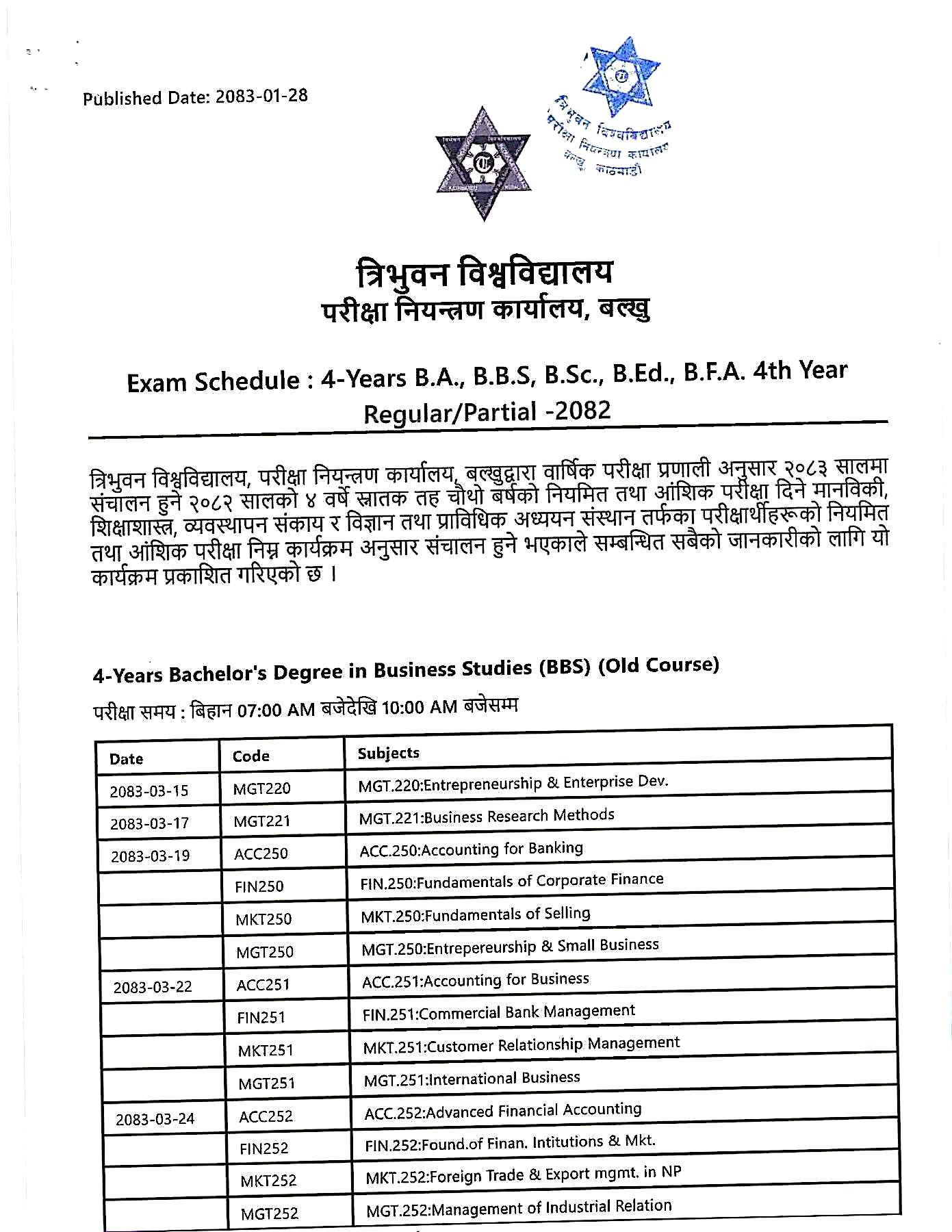
- TU 4-Years Bachelor Fourth Year Routine 2082 Regular / Partial
 TU 4-Years Bachelor Fourth Year Routine 2082 Regular / Partial Are you preparing for your Tribhuvan University (TU) back exams? The Office of the Controller of Examinations, Balkhu has officially published the TU 4-Years Bachelor Fourth Year Routine 2082…
Read More “TU 4-Years Bachelor Fourth Year Routine 2082 Regular / Partial” »
- Grade 12 Chemistry Question Papers 2083 (2026) | PDF
 Grade 12 Chemistry Question Papers 2083 (2026) | PDF If you are a Grade 12 student preparing for your NEB board exam. This post is for you. Here, we are sharing the Grade 12 Chemistry Question Papers 2083 (2026)…
Read More “Grade 12 Chemistry Question Papers 2083 (2026) | PDF” »
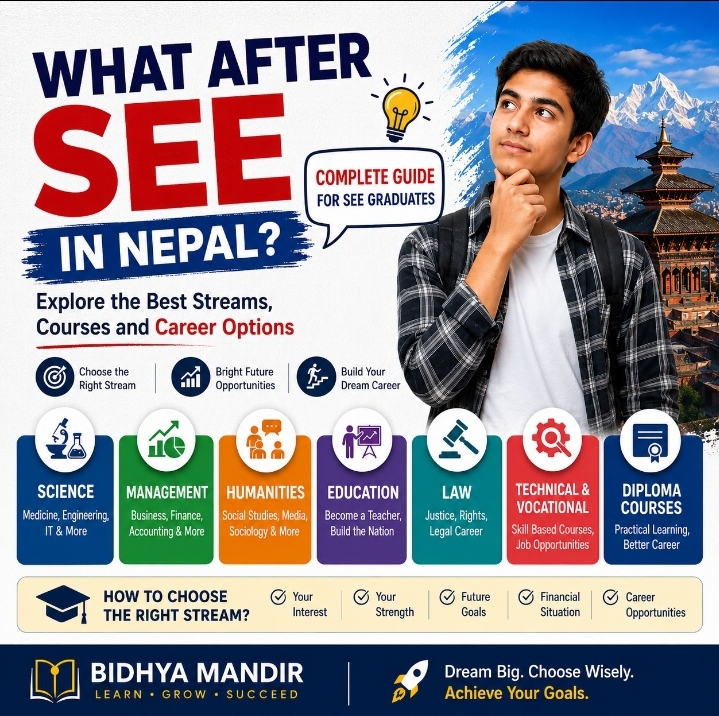
- What After SEE in Nepal?
 What After SEE in Nepal? The thousands of students in Nepal complete the SEE examination and face one important question: “What should I do after SEE?” This is one of the biggest decisions in a student’s life because the…
 - Koshi Province (4th Level) First Paper 2083-01-26 with AnswersKoshi Province (4th Level) First Paper 2083-01-26 with Answers Hello Loksewa Aspirants! Are you seeking Koshi Fourth Level first paper exam questions papers of 2082/83 ? Yes, you are in the right place. We have the best collection of…
Read More “Koshi Province (4th Level) First Paper 2083-01-26 with Answers” »
- Kharidar First Paper Exam 2083-01-26 with Answers PDF
 Kharidar First Paper Exam 2083-01-26 with Answers PDF Hello Loksewa Aspirants! Are you seeking Kharidar first paper exam questions papers of 2082/83 ? Yes, you are in the right place. We have the best collection of Kharidar First Paper…
Read More “Kharidar First Paper Exam 2083-01-26 with Answers PDF” »